



What are microplastics?
Everything you need to know about microplastics in drinking water
Microplastics are everywhere around us today
Just a few decades ago, plastic was a symbol of progress. Thanks to its durability, low weight, and wide range of uses, it became an indispensable material in packaging, construction, the automotive industry, medicine, and many other sectors.
However, that very durability is now one of the biggest environmental challenges.
Plastic breaks down very slowly in nature. Instead of disappearing, it fragments into ever smaller particles under the influence of sunlight, weather conditions, and mechanical wear. These particles are called microplastics.
Today, researchers detect them almost everywhere— in rivers, lakes, oceans, the air, soil, precipitation, and also in drinking water.
What are microplastics?
Microplastics are plastic particles smaller than 5 millimetres.
Their size can vary greatly—from particles a few millimetres in size to microscopic particles that can only be detected with advanced laboratory equipment.
They are most commonly divided into two groups.
Primary microplastics
These are particles that are already manufactured in very small sizes. They are used as raw material in industry or in the production of various plastic products.
Secondary microplastics
Much more common are secondary microplastics, which form as larger plastic items break down.
Breakdown is influenced by:
- sunlight (UV radiation),
- rain,
- wind,
- temperature changes,
- mechanical wear,
- time.
Over the years, every larger plastic item gradually breaks down into ever smaller particles.
Where do microplastics come from?
Microplastics do not enter the environment from a single source.
The most common sources are:
- plastic packaging,
- plastic bottles,
- synthetic textile fibres,
- wear from car tyres,
- industrial processes,
- wear of various plastic products.
Because plastic breaks down very slowly, the amount of it in the environment increases year after year.
Where can we find them?
Research shows that microplastics are not limited to the oceans.
They are also present in:
- rivers,
- lakes,
- groundwater,
- the air,
- soil,
- precipitation,
- drinking water.
This means they have become part of our everyday environment.
Why are microplastics so challenging to study?
At first glance, one might think microplastics are always the same.
In reality, it is quite the opposite.
Each particle can differ in:
- size,
- shape,
- colour,
- type of plastic (polymer),
- how it was formed,
- degree of degradation.
Precisely because of these differences, microplastics analysis is considerably more demanding than standard laboratory water analyses.
Can we see microplastics?
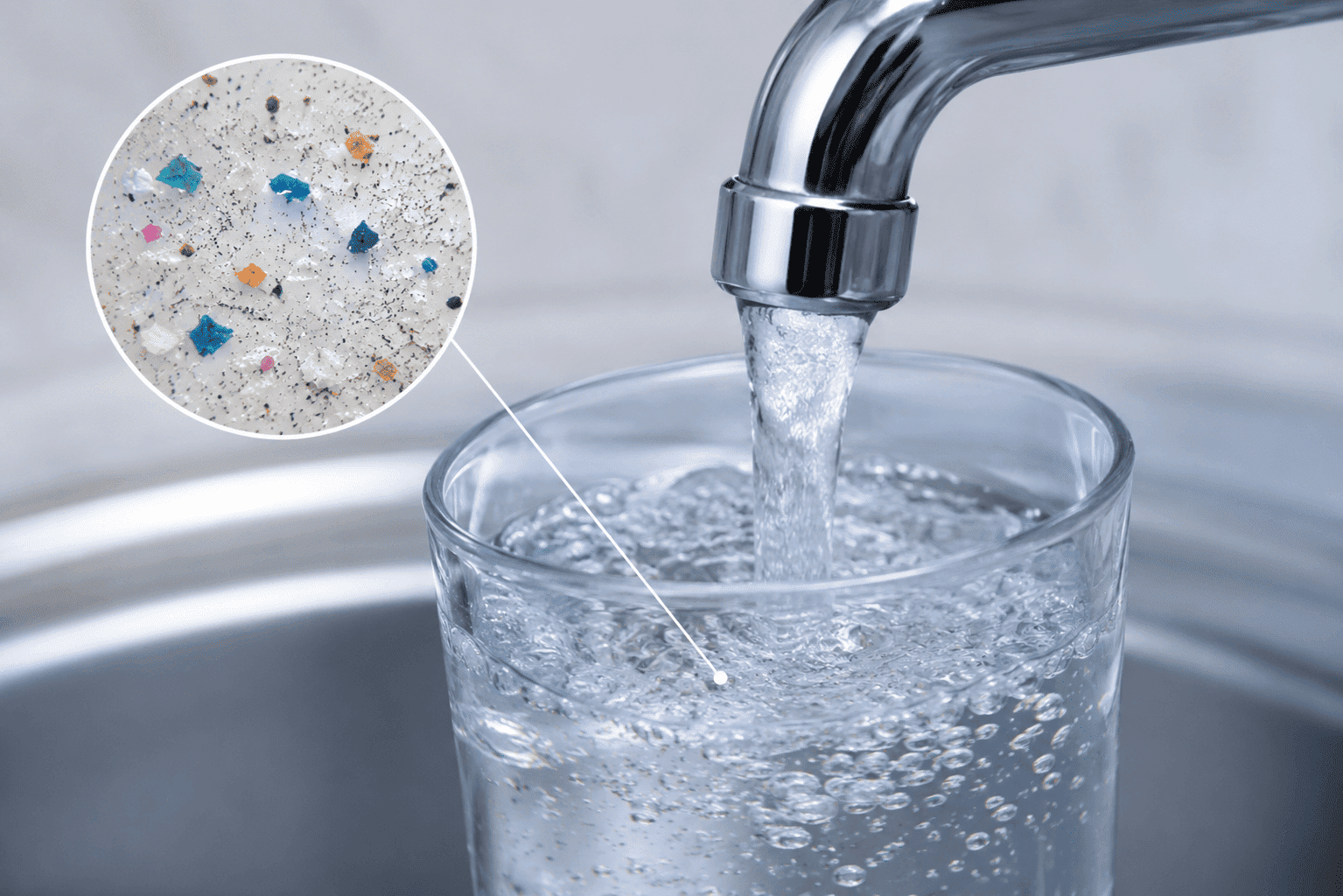
Most microplastic particles cannot be seen with the naked eye.
Water can be completely clear, odourless, and pleasant-tasting, but that does not mean it does not contain microscopic particles.
The presence of microplastics can only be reliably confirmed using appropriate laboratory methods.
Why is microplastics discussed much more today than in the past?
A major reason is not only the greater presence of plastic in the environment, but also advances in science.
Modern laboratory methods make it possible to detect significantly smaller particles than could be analysed ten or twenty years ago.
As a result, researchers today understand the prevalence of microplastics and their pathways in the environment much better.
What does science say?
Microplastics are one of the fastest-growing areas of environmental research.
The World Health Organization (WHO) and many other scientific institutions emphasise that much more research is still needed, especially regarding the impact of microplastics on human health.
Today, we can say with certainty that microplastics are present in the environment and can also be detected in drinking water. However, science is still investigating many questions about their long-term impact.
Why is microplastics analysis important?
Because microplastics cannot be detected with the naked eye, laboratory analysis is the only way to characterise the particles in a specific water sample in detail.
Modern analyses make it possible to determine:
- the number of particles,
- size,
- shape,
- colour,
- polymer type.
This data helps to better understand the composition of the sample and provides an important basis for further research and the development of effective solutions for monitoring drinking water quality.
Summary
- Microplastics are plastic particles smaller than 5 mm.
- They are mainly formed by the breakdown of larger plastic products.
- They are present in water, air, soil, and many other parts of the environment.
- Most particles cannot be seen with the naked eye.
- Their presence can only be determined through appropriate laboratory analyses.
ARTICLE FROM THE SITE – AguaLab d.o.o.
SOURCE: https://analizavode.si/blog/kaj-je-mikroplastika